FANUC MT-LINKI: A SIMPLE DATA COLLECTION METHOD

Continuous monitoring of the machine park
The revolution of Industry 4.0 is just a click away with FANUC MT-LINKi. This integrated PC software enables the collection of CNC data and monitoring of production equipment, such as machine tools, robots and PLCs. The system allows you to connect the machine park of your smart factory to production control and supervision systems, thus providing several benefits including analysis of production status, fault detection and optimised resource planning.
FANUC MT-LINKi allows you to monitor the production status of the entire factory in real time and in an intuitive way. In the event of faults or breakdowns, the system promptly activates the appropriate safety measures, sending alarm notifications to the operator. No special hardware is required to install the software, and configuration is quick and easy.
360-degree supervision and diagnostics
With FANUC MT-LINKi you can review the operating data of each individual machine at any time, and compare them with the production schedule. In addition, you can check the degree of use of the equipment, identifying any that are not used very often. This allows you to optimise the planning of the factory resources.
All diagnostic data, such as alarm and programme history, can be viewed directly on the computer. Planning and preparation of reports in Excel format also becomes automatic with FANUC MT-LINKi.
Choose Assistec, choose FANUC MT-LINKi
In addition to being a leader in the field of electronic and mechanical support, Assistec is an authorised dealer of FANUC MT-LINKi. Contact us and ask for a quote, our System Integration experts will guide you through all the stages of software integration, from installation to direct assistance.
Recent Posts

-
PLC logic for machine safety is one of the areas that may require attention when an existing machine tool has outdated or inadequate safety functions, or when these functions are no longer suitable for the machine’s current configuration.
However, improving machine safety is not simply a matter of modifying a few lines of PLC code. The process must begin with a risk assessment, followed by identifying the required safety functions, checking the devices already installed and determining how they should interact with the PLC, drives, sensors, interlocks and machine components.
On CNC machine tools, changes to PLC logic may be required, for example, to correctly manage automatic doors, permissive signals, stopping functions, protective devices or newly integrated automation systems.
For this reason, modifying PLC logic should be considered part of a broader machine safety and functional verification process, rather than an isolated software task.
-
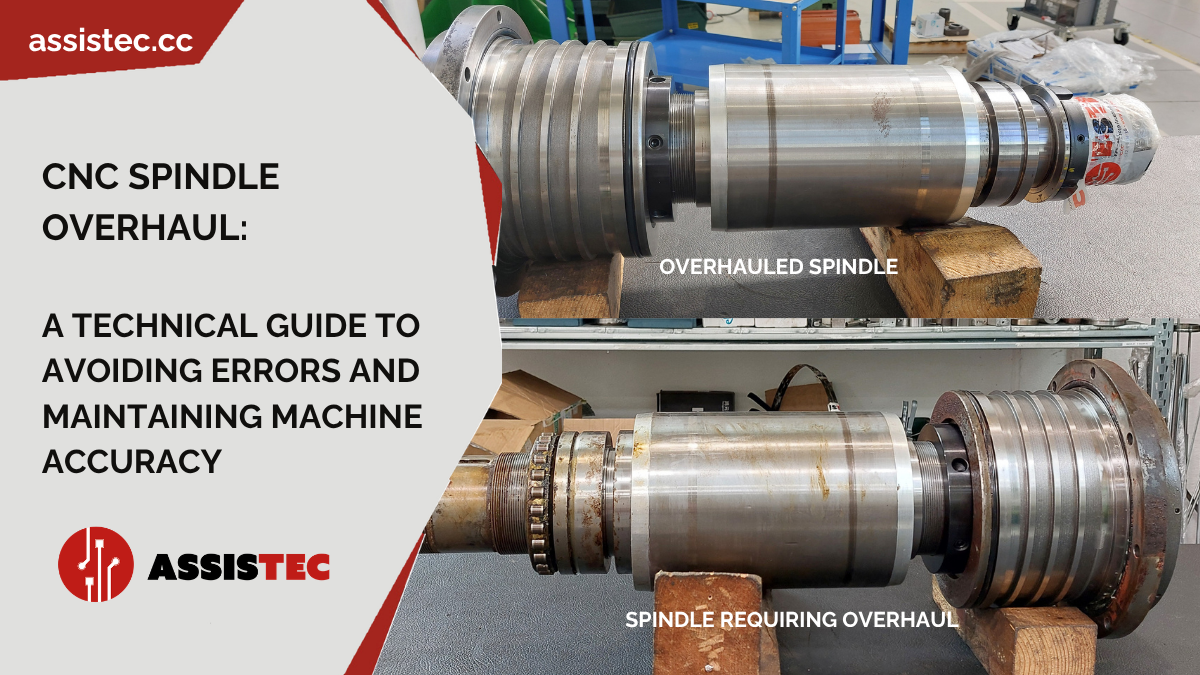
The CNC spindle is one of the most important elements of a machine tool: it is the component that transmits motion to the tool and, together with the machine’s other systems, determines precision, machining quality and production reliability.
When a spindle begins to show signs of wear, the problem is not limited to the component itself. Abnormal vibrations, loss of precision or increased noise levels can, in fact, compromise the entire production process, leading to scrap, premature tool wear and unscheduled machine downtime.
For this reason, the overhaul of CNC spindles should not be regarded as a simple repair job, but as a technical operation aimed at restoring the spindle to its original operating condition and ensuring stability and precision once again.
Relying on a professional service allows the real causes of the problem to be identified, worn components to be replaced and more serious faults that could halt production to be prevented.
-
Fanuc CNC Spare Parts: How to Identify Part Numbers, Check Availability and Reduce Machine Downtime
When a CNC machine tool comes to a standstill due to a fault, time becomes the most critical factor. Every hour of downtime can result in production delays, postponed deliveries and costs that often far exceed the value of the component to be replaced.
In such cases, finding the correct spare part is not simply a purchasing task, but a strategic step that directly affects the company’s operational continuity.
For this reason, understanding how Fanuc CNC spare parts work, knowing how to correctly identify spare part codes and being able to rely on rapid availability represents a tangible advantage for maintenance managers, procurement departments and mechanical workshops that work with CNC machine tools on a daily basis.