Assistec e Renishaw: una partnership che anticipa il futuro della produzione industriale

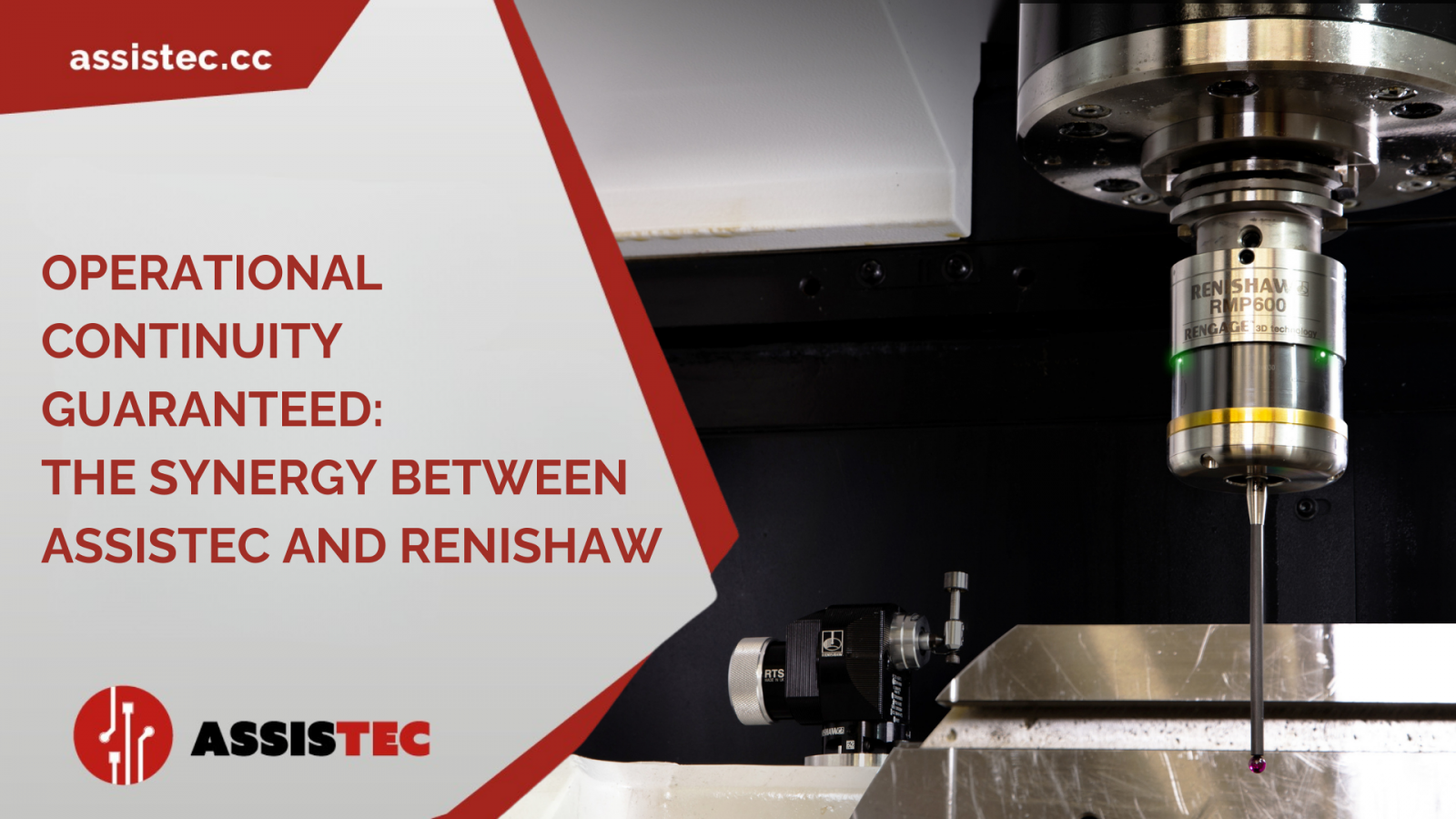
Assistec and Renishaw: a partnership that anticipates the future of industrial manufacturing
A synergy is born that can redefine the standards of the manufacturing industry. This is the scenario that came to life at MECSPE, where Assistec and Renishaw joined forces in a joint exhibition that left no doubt: the future of manufacturing is integrated, intelligent and collaborative. At the heart of the exhibition, a European benchmark for industrial innovation, the two companies presented real and operational solutions that fuse advanced robotics and quality control in a single platform. A tangible demonstration of how the challenges of the modern factory - efficiency, flexibility and zero defects - can be addressed with interconnected technologies and complementary visions.
Industry 4.0 integration: automation and quality control meet
In an increasingly competitive and interconnected industrial landscape, the MECSPE exhibition represents the centre of gravity for innovations in advanced manufacturing. The most recent edition witnessed the emergence of a strategic partnership between two excellences in the sector: Assistec, a leader in technical support for numerically controlled (CNC) machine tools, and Renishaw, a global benchmark for metrology and dimensional control technologies. Their joint presence testified to a clear vision: to integrate robotics and quality control into a single flexible, mobile and intelligent solution. A concrete proposal for manufacturing companies that want to face the challenges of Industry 4.0 with ready-to-use tools capable of generating immediate value.
The flexibility of robotics in the service of quality control
One of the solutions presented at the trade fair sees the fusion of two components capable of working in perfect synergy. On the one hand, ROBO FEED's C21 mobile collaborative cell, designed to be easily moved from one machine tool to another and thus meet the flexibility and modularity requirements of modern machine shops. On the other hand, Equator, Renishaw's patented automatic part comparison system. Unlike traditional measurement systems that require controlled environments, Equator works directly in-line with production, alongside the CNC machine, offering fast, accurate and reliable verification even under varying temperature conditions.
How integration works: a closed loop for continuous optimisation
The combined operation of the C21 cell with Equator makes it possible to create a true closed loop of automatic control and correction:
•The Fanuc CRX-20iA/L cobot of the C21 cell safely moves the machined parts from the CNC machine to the Equator system.
• Equator performs a comparative dimensional check between the part produced and a reference sample, recording any deviations or deviations in real time
• Measurement data can be sent directly to the machine tool to correct machining parameters, ensuring production is always under control and drastically reducing the margin of error.
Tangible benefits for manufacturing companies
Tangible benefits for manufacturing companies This solution enables machine shops to
• Minimise production waste by intervening in real time before the problem spreads;
• Avoid late rework, which results in machine downtime, loss of time and additional costs;
• Optimising process quality without burdening the operator, who can concentrate on higher value activities;
• Making production flows more agile and reconfigurable, thanks to the mobility of the cell and the system's intuitive interface.
All without the need for air-conditioned environments, specialised metrology personnel or long installation times.
This collaboration has resulted in a turnkey solution that perfectly embodies the principles of Industry 4.0 and 5.0: intelligence, adaptability, interoperability.
Renishaw and Assistec: more efficiency, less downtime
The integration of automation and metrology is not limited to production: it also plays a key role in technical support services. This is where another distinctive aspect of the collaboration between Assistec and Renishaw comes into play: the use of measurement technology in service work as well. Thanks to our company's experience in the field of service on Fanuc robots, CNC machines and robot cells, technical intervention becomes not only faster, but also more precise and predictive.
Renishaw part probes: instant diagnosis and guaranteed reliability
Renishaw's part probes, used during maintenance, allow direct inspection of the machined part, identifying
• Positioning errors or misalignments;
• Geometric anomalies;
• Deviations from the standard part.
This results in timely diagnosis, highly targeted interventions and a significant reduction in downtime. An approach geared towards production continuity and safeguarding quality.
Tool setting systems: more precision, fewer errors
A further part of the shared strategy is the use of Renishaw tool setting systems during installation, calibration or maintenance.
These devices:
• They eliminate manual adjustment times, simplifying tool setup;
• They improve machining accuracy, avoiding rejects due to initial errors;
• They prolong tool life, reducing stress from misuse.
The result is a service process that does not just “repair”, but optimises working conditions from the very first intervention.
Intelligent automation: towards increasingly connected production
The successful integration of Assistec and Renishaw is not just a technical issue, but also a strategic one. Indeed, manufacturing companies are increasingly looking for solutions that enable intelligent process management. This means having tools that communicate with each other, collect data in real time and return useful information for quick and targeted decision-making. In this scenario, the combination of collaborative robotics, measurement systems and digital monitoring tools represents the beating heart of the smart factory. Assistec and Renishaw are actively contributing to building this new manufacturing paradigm, based on automation, precision and adaptability.
An integrated vision combining quality and automation in a single strategy
From production to service: technological continuity for operational excellence. The joint participation of Assistec and Renishaw at MECSPE 2025 sent out a strong and clear message: technical/electronic support and metrology are no longer watertight compartments, but synergic levers for an integrated industrial strategy.
Investing in solutions such as the C21 mobile collaborative cell integrated with the Equator system, supported by control tools such as part probes and tool setters, means equipping yourself with a complete ecosystem capable of:
- Improve process quality;
- Increase overall productivity;
- Enhance market competitiveness;
- Ensure business continuity even in the event of technical interventions.
Assistec and Renishaw do not just offer services: they offer an intelligent factory model, in which each component is designed to dialogue with the others, with a view to efficiency, precision and sustainability.
Recent Posts

-
Technical support for Mazak machines: on-site electronic and mechanical repairs
Mazak machine tools are found in numerous workshops and production departments and, particularly in the case of machines that have been in operation for several years, may require electronic and mechanical repairs to resolve faults, malfunctions or issues related to component wear.
However, a machine stoppage does not always allow the root cause of the problem to be identified immediately.
A fault may affect the control system, a drive or an electronic component, but it may also be due to mechanical elements, the tool changer, the pallet changer system or the machine’s geometric conditions.
For this reason, the ability to carry out an analysis directly at the customer’s premises allows us to assess the machine’s actual behaviour and identify the necessary intervention.
Assistec provides on-site electronic and mechanical support services, including for Mazak machines fitted with Mazatrol 640 and Mitsubishi M64 control systems, drawing on the expertise it has developed in servicing multi-brand CNC machine tools.
-
PLC logic for machine safety is one of the areas that may require attention when an existing machine tool has outdated or inadequate safety functions, or when these functions are no longer suitable for the machine’s current configuration.
However, improving machine safety is not simply a matter of modifying a few lines of PLC code. The process must begin with a risk assessment, followed by identifying the required safety functions, checking the devices already installed and determining how they should interact with the PLC, drives, sensors, interlocks and machine components.
On CNC machine tools, changes to PLC logic may be required, for example, to correctly manage automatic doors, permissive signals, stopping functions, protective devices or newly integrated automation systems.
For this reason, modifying PLC logic should be considered part of a broader machine safety and functional verification process, rather than an isolated software task.
-
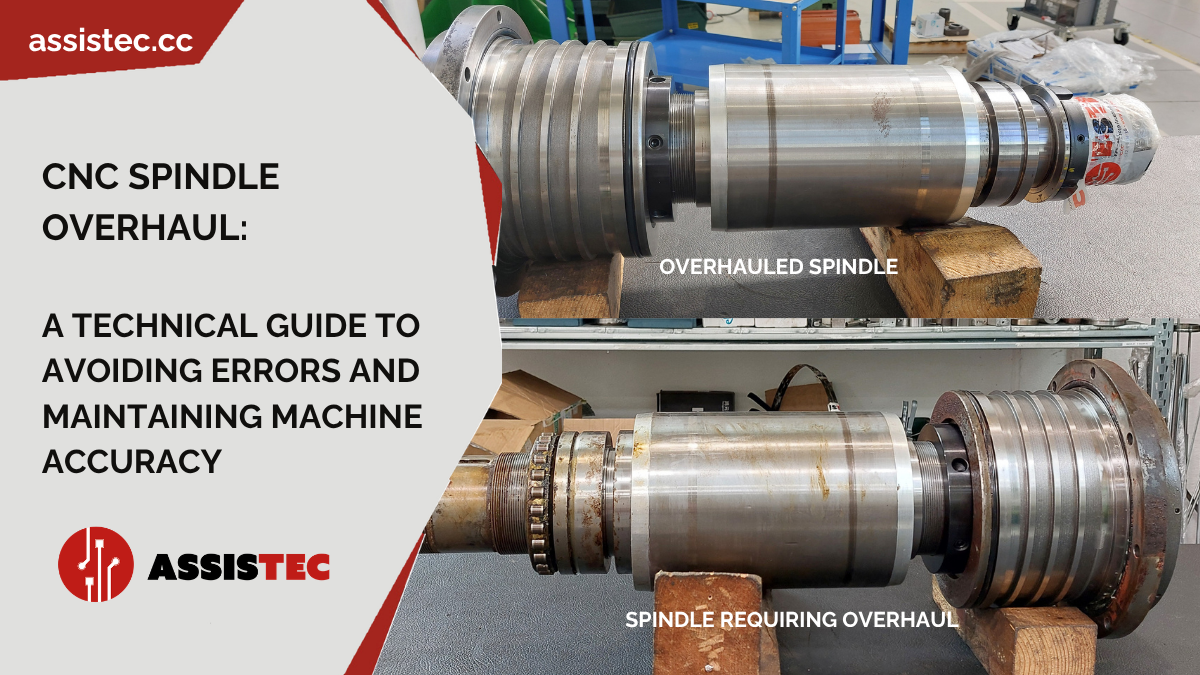
The CNC spindle is one of the most important elements of a machine tool: it is the component that transmits motion to the tool and, together with the machine’s other systems, determines precision, machining quality and production reliability.
When a spindle begins to show signs of wear, the problem is not limited to the component itself. Abnormal vibrations, loss of precision or increased noise levels can, in fact, compromise the entire production process, leading to scrap, premature tool wear and unscheduled machine downtime.
For this reason, the overhaul of CNC spindles should not be regarded as a simple repair job, but as a technical operation aimed at restoring the spindle to its original operating condition and ensuring stability and precision once again.
Relying on a professional service allows the real causes of the problem to be identified, worn components to be replaced and more serious faults that could halt production to be prevented.