
CNC Spindle Overhaul: A Technical Guide to Avoiding Errors and Maintaining Machine Accuracy

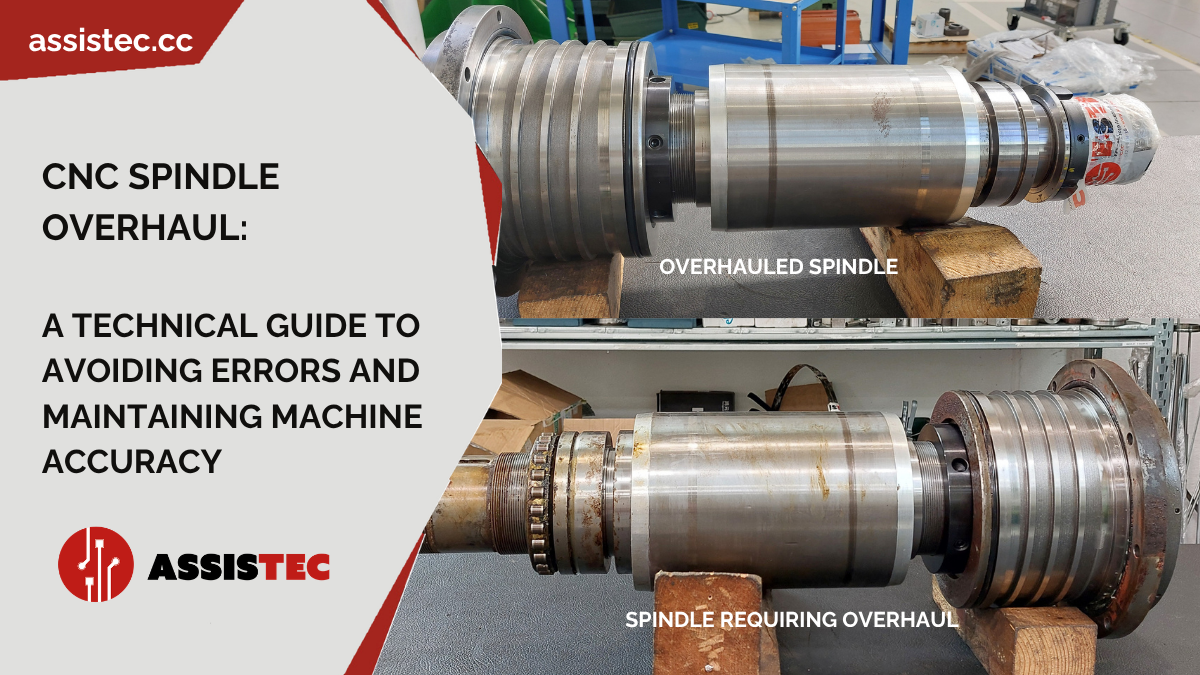
The CNC spindle is one of the most important elements of a machine tool: it is the component that transfers motion to the tool and, together with the machine’s other systems, determines precision, machining quality and production reliability.
When a spindle begins to show signs of wear, the problem is not limited to the component itself. Abnormal vibrations, loss of precision or increased noise levels can, in fact, compromise the entire production process, leading to scrap, premature tool wear and unscheduled machine downtime.
For this reason, the overhaul of CNC spindles should not be regarded as a simple repair job, but as a technical procedure aimed at restoring the spindle to its original operating condition and ensuring stability and precision once again.
Relying on a professional service allows the actual causes of the problem to be identified, worn components to be replaced and more serious faults that could halt production to be prevented.
Why does a CNC spindle need servicing?
During the normal production cycle, the spindle is continuously subjected to high stresses:
- high rotational speeds;
- load variations during machining;
- vibrations generated by the chip removal process;
- contamination from dust, coolant or machining residues.
Over time, these factors can cause progressive deterioration of internal components, particularly the bearings, mating surfaces and lubrication systems.
A spindle operating under sub-optimal conditions can give rise to a series of problems that initially seem minor but can quickly turn into critical issues:
- deterioration in the surface finish of workpieces;
- a reduction in dimensional accuracy;
- increased tool wear;
- risk of sudden machine downtime.
Taking action before complete failure therefore helps to reduce overall maintenance costs and minimise machine tool downtime.
When should a CNC spindle be serviced?
A sudden breakdown is not always the first sign of a problem. In most cases, the spindle gives off certain progressive warning signs that can be identified through a proper diagnosis.
Among the most frequent indicators are:
Increased spindle vibration
Vibration is one of the most common symptoms of a problem with the spindle assembly.
They can stem from various causes:
- imbalance of the rotating assembly;
- wear of the bearings;
- damage to internal surfaces;
- assembly issues;
- faults with the tool holder or the tool itself.
Ignoring persistent vibrations means subjecting the spindle to abnormal stresses that accelerate the deterioration of its components.
Abnormal noise during operation
A noise that differs from normal operation may indicate internal friction, lubrication problems or bearing wear.
Particularly in high-precision, high-speed machining, even seemingly minor variations must be analysed.
Loss of precision and surface quality
When the spindle no longer maintains the correct stability, the result may be directly evident on the machined workpiece:
- less uniform surfaces;
- dimensional tolerances outside specification;
- less precise machining.
In such cases, a CNC spindle overhaul allows the source of the problem to be identified and the machine’s performance to be restored.
How a CNC spindle is overhauled
A professional overhaul is not simply a matter of replacing a worn component. It is a structured process that requires analysis, experience and the appropriate tools.
1. Initial diagnosis and analysis of the problem
Before dismantling, it is essential to understand how the spindle behaves during operation.
The diagnosis allows us to assess:
- the presence and intensity of vibrations;
- operating conditions;
- any mechanical or electrical faults;
- the machine’s history of problems.
A proper initial analysis, even carried out remotely, prevents unnecessary interventions and enables the actual cause of the malfunction to be identified.
2. Dismantling and inspection of internal components
During the overhaul, the spindle is analysed in terms of its main components:
- bearings;
- shafts;
- lubrication systems;
- fasteners;
- mating surfaces.
Each component is inspected to determine whether repair is possible or whether replacement is necessary.
3. Spindle balancing
CNC spindle balancing is a crucial step in ensuring the correct operation of the rotating assembly.
Even the slightest imbalance, particularly at high speeds, can generate high centrifugal forces responsible for:
- vibrations;
- premature bearing wear;
- deterioration in machining quality;
- reduction in the overall service life of the spindle.
A correctly balanced spindle, on the other hand, ensures greater stability, precision and reliability over time.
4. Final testing and inspection
Once the overhaul is complete, the spindle must undergo tests to verify that its performance has been restored.
The tests may include:
- vibration testing;
- dynamic operation testing;
- accuracy testing;
- analysis of operating conditions.
Only through a comprehensive test can it be guaranteed that the component is truly ready to return to production.
The most common mistakes in dealing with CNC spindle problems
Many problems could be avoided with proper preventive maintenance. Some of the most frequent mistakes in workshops relate precisely to how the first signs of a fault are handled.
Continuing to work with noticeable vibrations
An initial vibration rarely remains stable over time. Continuing to use the machine without analysing the problem can lead to more rapid deterioration of the spindle.
Replacing components without identifying the cause
Replacing a bearing or a worn part without analysing the root cause of the problem may lead to the fault reoccurring shortly afterwards.
An effective repair must take the entire system into account: spindle, tool, tool holder, machining conditions and machine parameters.
Neglecting balancing
Balancing is not a minor detail, especially in high-speed machining.
An unbalanced rotating assembly progressively compromises the precision and service life of components.
Only carry out maintenance after the machine has been shut down
Waiting until a complete failure occurs often means facing higher costs, longer downtime and difficulties in sourcing replacement components.
A scheduled overhaul allows you to plan the work and minimise the impact on production.
Electrospindle overhaul: why it requires specific expertise
Electrospindles incorporate mechanical and electronic features that make their overhaul a highly specialised task.
In addition to the rotating components, the following must also be assessed:
- integrated motor;
- sensors;
- cooling systems;
- electrical control of the component.
A fault may therefore arise not only from a mechanical problem, but also from issues relating to the control electronics or thermal management.
For this reason, the overhaul of electric spindles requires cross-disciplinary expertise in machine tools and the installed CNC systems, such as those based on Fanuc and Siemens
technologies
To summarise...
When is it advisable to carry out an overhaul of a CNC spindle?
There is no single service interval that applies to all machines: the need for an overhaul depends on the type of machining, operating hours, rotational speeds and operating conditions.
In general, an overhaul is recommended when signs such as increased vibration, abnormal noise, loss of precision or a deterioration in the surface quality of machined parts become apparent.
Preventative maintenance allows action to be taken before the most critical components fail, thereby reducing the risk of machine downtime.
What are the main causes of CNC spindle vibrations?
Vibrations can have various causes: imbalance in the rotating assembly, bearing wear, assembly issues, incorrect machining conditions or tool holder faults.
To identify the actual cause, a comprehensive diagnosis is required, as addressing only the symptom may lead to the problem recurring shortly afterwards.
Why is spindle balancing important?
Balancing eliminates imbalances in the rotating assembly which, particularly at high speeds, can cause vibrations and damaging stresses.
A correctly balanced spindle improves machining stability, reduces wear on internal components and helps to maintain the machine tool’s precision for longer.
What is the difference between an overhaul and a simple repair of a CNC spindle?
A repair generally involves replacing a damaged component to restore functionality.
An overhaul, on the other hand, involves a complete inspection of the spindle: analysis of its internal condition, checking of components, replacement of any worn parts where necessary, balancing and final testing.
For high-precision applications, a complete overhaul offers greater assurance of long-term reliability.
How long does a CNC spindle overhaul take?
The duration of the work depends on the spindle model, the level of wear found and the availability of the necessary components.
An accurate initial diagnosis allows for a clearer definition of the timing and scope of the work, reducing the risk of unforeseen additional work.
Is it always necessary to replace a CNC spindle when it develops faults?
No. In many cases, a spindle can be restored to its original operating condition through a professional overhaul.
Whether this is more cost-effective than a complete replacement depends on the condition of the component, the value of the machine and the type of machining required. A technical analysis enables the most efficient solution to be identified from both a production and economic perspective.
CNC spindle overhaul: rely on a specialist partner
Overhauling a CNC spindle is a procedure that requires experience, suitable diagnostic tools and in-depth knowledge of machine tools.
Assistec has been providing electronic and mechanical support for CNC machine tools for over 25 years, assisting companies and workshops with fault management, major maintenance and the restoration of machine performance.
Thanks to its in-house mechanical workshop and specialist technicians, Assistec carries out the following services:
- inspection of spindles and electric spindles;
- geometric checks;
- dynamic tests;
- vibration analysis using specialised equipment;
- preventative and major maintenance.
There is just one objective: to reduce machine downtime and restore the production system to optimal levels of precision and reliability.
If your CNC spindle is experiencing vibrations, a loss of precision or operational faults, contact Assistec for a technical assessment and targeted intervention.
Recent Posts

-
PLC logic for machine safety is one of the areas that may require attention when an existing machine tool has outdated or inadequate safety functions, or when these functions are no longer suitable for the machine’s current configuration.
However, improving machine safety is not simply a matter of modifying a few lines of PLC code. The process must begin with a risk assessment, followed by identifying the required safety functions, checking the devices already installed and determining how they should interact with the PLC, drives, sensors, interlocks and machine components.
On CNC machine tools, changes to PLC logic may be required, for example, to correctly manage automatic doors, permissive signals, stopping functions, protective devices or newly integrated automation systems.
For this reason, modifying PLC logic should be considered part of a broader machine safety and functional verification process, rather than an isolated software task.
-
The CNC spindle is one of the most important elements of a machine tool: it is the component that transmits motion to the tool and, together with the machine’s other systems, determines precision, machining quality and production reliability.
When a spindle begins to show signs of wear, the problem is not limited to the component itself. Abnormal vibrations, loss of precision or increased noise levels can, in fact, compromise the entire production process, leading to scrap, premature tool wear and unscheduled machine downtime.
For this reason, the overhaul of CNC spindles should not be regarded as a simple repair job, but as a technical operation aimed at restoring the spindle to its original operating condition and ensuring stability and precision once again.
Relying on a professional service allows the real causes of the problem to be identified, worn components to be replaced and more serious faults that could halt production to be prevented.
-
Fanuc CNC Spare Parts: How to Identify Part Numbers, Check Availability and Reduce Machine Downtime
When a CNC machine tool comes to a standstill due to a fault, time becomes the most critical factor. Every hour of downtime can result in production delays, postponed deliveries and costs that often far exceed the value of the component to be replaced.
In such cases, finding the correct spare part is not simply a purchasing task, but a strategic step that directly affects the company’s operational continuity.
For this reason, understanding how Fanuc CNC spare parts work, knowing how to correctly identify spare part codes and being able to rely on rapid availability represents a tangible advantage for maintenance managers, procurement departments and mechanical workshops that work with CNC machine tools on a daily basis.