INDUSTRIAL AUTOMATION: ADVANTAGES FOR COMPANIES

More and more companies are using robots
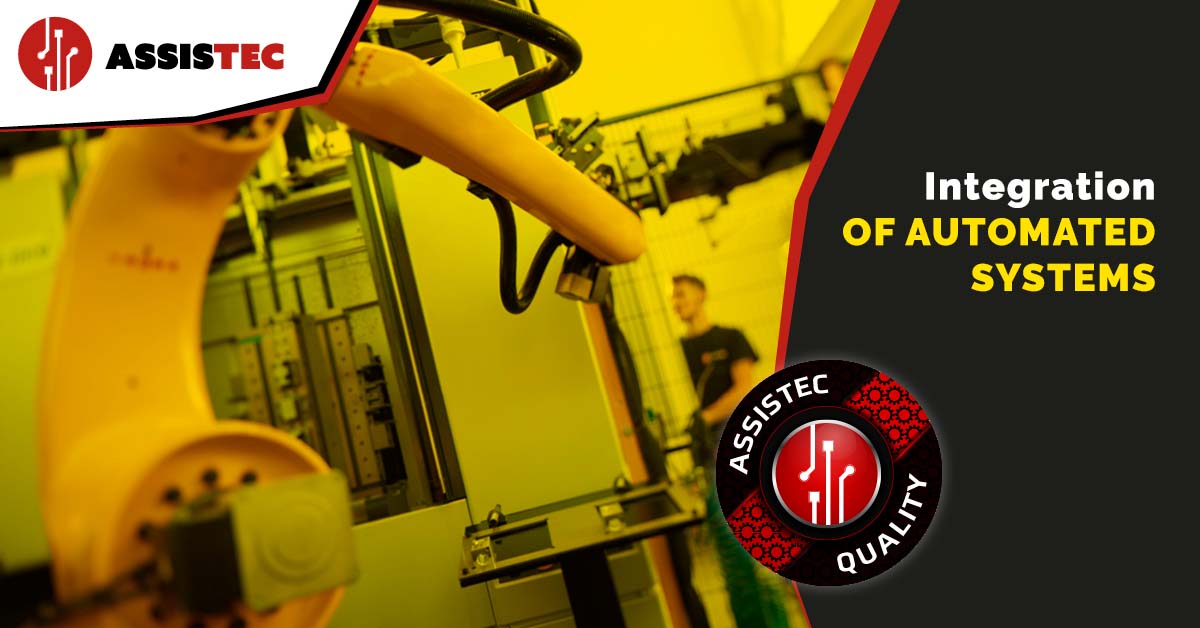
From welding to assembly, from machining components to loading and unloading of goods, there are countless ways of applying robots and machine tools in industries.
The advent of automation in business processes has marked the beginning of a new era, and there is even talk of a “fourth industrial revolution” or, more specifically, Industry 4.0. This ever-evolving phenomenon can facilitate the digital transformation of companies, bringing them closer to the smart factories of the future. Robots and machine tools are flexible tools that can be applied to an infinite number of operations.
Industrial automation makes us more efficient by increasing production. Human supervision is reduced to a minimum, relieving workers of dangerous and tiresome routine tasks, but the need for highly qualified personnel, such as electronic and mechanical engineers, becomes more important. The integration of robots, machine tools and robotic islands ensures consistently high performances and increased efficiency, reducing the margin of error. Industrial automation offers many advantages, here are just a few:
- Increased productivity
Unlike humans, artificial intelligence can perform multiple tasks at the same time, thus shortening production times. Regardless of whether the tasks are repetitive and tiring, requiring hours or days, the job is always completed efficiently. The machine’s production pace perceptibly exceeds the speed of manual processes, thanks to consistent, high-level performances.
- Guaranteed reliability and quality
Industrial automation significantly reduces the risk of gaps and errors often caused by manual processes. Product quality improves, reducing personnel costs. Moreover, thanks to the latest generation software and digital programming, it is possible to determine the duration of processes, organise the workflow and make predictions on the reliability of results.
- Greater job security
The growth in demand for high quality goods, closely linked to population growth, has led to mass production. This obviously also led to a dramatic increase in occupational hazards for workers, with exhausting production rhythms and risky tasks. The systems introduced by industrial automation, on the other hand, are able to relieve humans of these tasks. Workers in smart factories become specialised resources for monitoring and servicing robots and machine tools, leaving them with all those tasks that involve greater risks
- Reduction of waste
Automated systems are much more accurate and precise than humans. This allows companies to make 100% use of raw materials, thus considerably reducing the amount of waste. More efficient use of raw materials means less production waste and therefore lower disposal costs.
Discover the advantages of industrial automation with Assistec.
Assistec's technical assistance and system integrator services, makes industrial automation easier and more profitable. The experience of our highly specialised electronic and mechanical engineers guarantees the optimisation of production processes and interfacing between robots and machine tools. We take meticulous care in all phases of design, manufacture, and installation of robotic islands.
A winning factor at Assistec is the analysis of the company's production cycle, in order to create custom designed systems. This offers flexibility and autonomy to robots and machine tools, avoiding constant operator intervention. We believe that industrial automation is the key to Industry 4.0.
A smart factory where humans are digitally interconnected with electronic and mechanical systems
Recent Posts

-
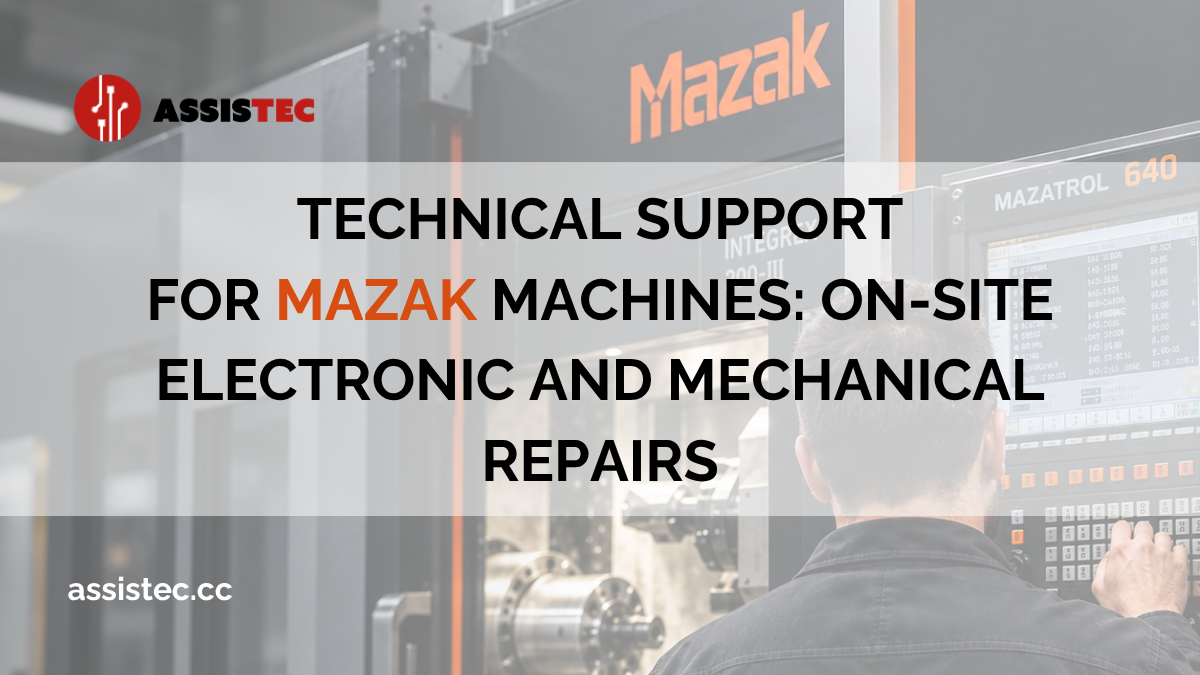
Technical support for Mazak machines: on-site electronic and mechanical repairs
Mazak machine tools are found in numerous workshops and production departments and, particularly in the case of machines that have been in operation for several years, may require electronic and mechanical repairs to resolve faults, malfunctions or issues related to component wear.
However, a machine stoppage does not always allow the root cause of the problem to be identified immediately.
A fault may affect the control system, a drive or an electronic component, but it may also be due to mechanical elements, the tool changer, the pallet changer system or the machine’s geometric conditions.
For this reason, the ability to carry out an analysis directly at the customer’s premises allows us to assess the machine’s actual behaviour and identify the necessary intervention.
Assistec provides on-site electronic and mechanical support services, including for Mazak machines fitted with Mazatrol 640 and Mitsubishi M64 control systems, drawing on the expertise it has developed in servicing multi-brand CNC machine tools.
-
PLC logic for machine safety is one of the areas that may require attention when an existing machine tool has outdated or inadequate safety functions, or when these functions are no longer suitable for the machine’s current configuration.
However, improving machine safety is not simply a matter of modifying a few lines of PLC code. The process must begin with a risk assessment, followed by identifying the required safety functions, checking the devices already installed and determining how they should interact with the PLC, drives, sensors, interlocks and machine components.
On CNC machine tools, changes to PLC logic may be required, for example, to correctly manage automatic doors, permissive signals, stopping functions, protective devices or newly integrated automation systems.
For this reason, modifying PLC logic should be considered part of a broader machine safety and functional verification process, rather than an isolated software task.
-
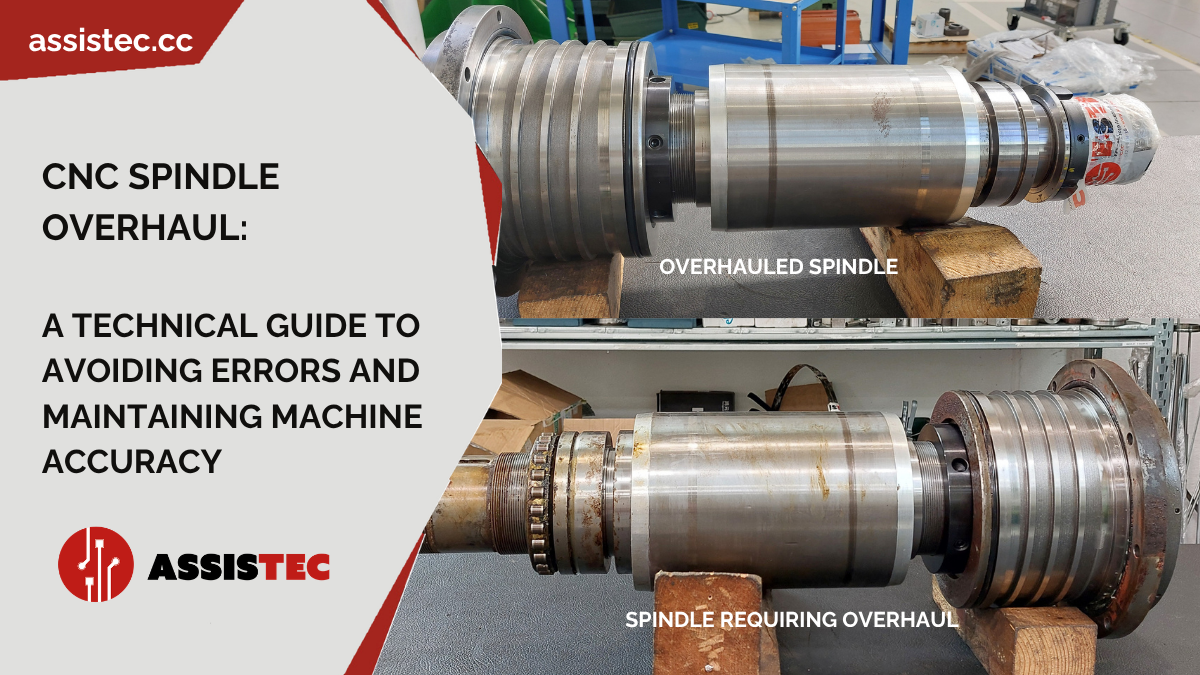
The CNC spindle is one of the most important elements of a machine tool: it is the component that transmits motion to the tool and, together with the machine’s other systems, determines precision, machining quality and production reliability.
When a spindle begins to show signs of wear, the problem is not limited to the component itself. Abnormal vibrations, loss of precision or increased noise levels can, in fact, compromise the entire production process, leading to scrap, premature tool wear and unscheduled machine downtime.
For this reason, the overhaul of CNC spindles should not be regarded as a simple repair job, but as a technical operation aimed at restoring the spindle to its original operating condition and ensuring stability and precision once again.
Relying on a professional service allows the real causes of the problem to be identified, worn components to be replaced and more serious faults that could halt production to be prevented.